How Do You Start Forex Trading as a Beginner in 2026?
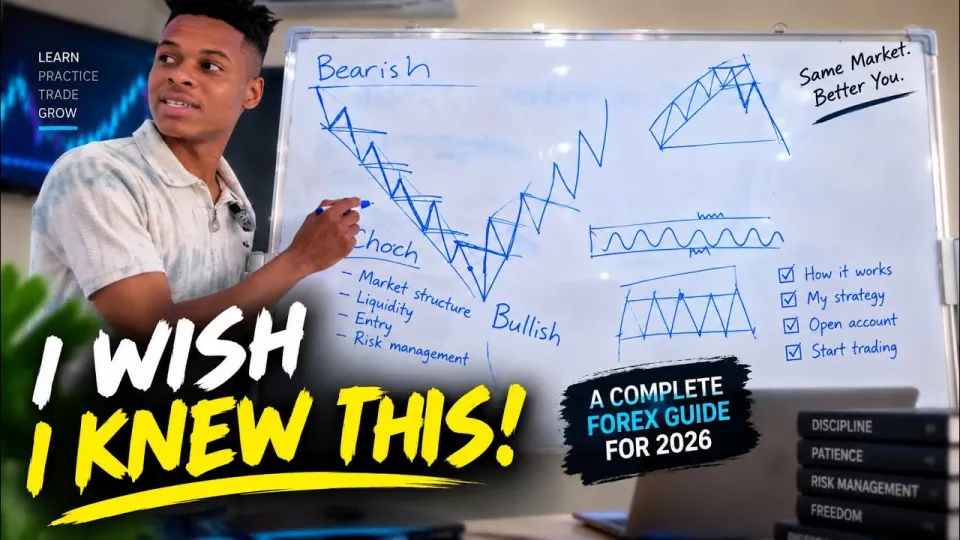
Video: How To Start Forex Trading For Beginners in 2026 (Full Guide + My Strategy)
You can order the same kind of articles for your own video to boost it on YouTube and Google. Just message the Telegram bot @sat_sit_bot. It writes articles around your video, embeds the video and publishes them on popular niche websites (no ads). Free trial — 50 articles.
· based on the channel Carl Fx
Forex trading is the practice of buying and selling currencies on the foreign exchange market, and to start as a beginner in 2026 you need three things: a regulated broker account, a grasp of market structure, and a simple strategy you can test on a demo. This guide walks through each step, based on the framework shared by Carl Fx in his full beginner walkthrough, and points you to TFC Global Markets registration where you can open an account.
What is forex and how does the market actually work?
Forex is a decentralized global marketplace where currencies are traded in pairs, and its daily turnover exceeds $7 trillion, making it the largest financial market in the world. Unlike stocks, there is no central exchange; trading happens over-the-counter (OTC) between banks, institutions, and retail brokers. The most traded pairs include EUR/USD, USD/JPY, and GBP/USD, and the US dollar is on one side of roughly 88% of all trades. Retail traders access this market through brokers, typically using leverage to control larger positions with smaller capital. Prices move based on supply and demand, driven by interest rates, inflation data, geopolitical events, and market sentiment.
How do you open a forex trading account from zero?
Opening a forex trading account starts with choosing a broker that fits your needs, and the process typically takes minutes online. Here are the key steps:
- Choose a regulated broker. Look for oversight from authorities like the FCA, ASIC, or CySEC. Carl Fx owns TFC Global Markets, and you can sign up through his TFC Global Markets link.
- Register and verify your identity. You'll provide your name, email, and government-issued ID. Verification is required for anti-money-laundering compliance.
- Fund your account. Start with a small amount you can afford to lose. Many brokers offer micro lots, allowing you to trade with as little as $10–$50 per position.
- Practice on a demo account. Use virtual money to test strategies without risking real capital. Most brokers provide unlimited demo accounts.
- Transition to live trading gradually. Begin with a small live account once you've consistently followed your plan on demo for at least a few weeks.
How do you read bullish and bearish market structure?
Market structure is the pattern of highs and lows on a price chart, and it tells you whether buyers or sellers are in control. In a bullish market, price makes higher highs and higher lows—each rally exceeds the previous peak, and each pullback stays above the prior trough. In a bearish market, price makes lower highs and lower lows. When this pattern breaks—for example, a bullish trend fails to make a higher high and then breaks below the last higher low—it signals a potential trend reversal. Understanding these swings is the foundation of price action trading, and it helps you avoid entering trades against the dominant flow. Carl Fx emphasizes that market structure is the first thing a beginner should master before learning any strategy.
What is a simple forex trading strategy for beginners?
A simple strategy combines trend identification with a clear entry trigger and predefined risk, and Carl Fx demonstrates one based on market structure and pullbacks. Here is a basic framework:
- Identify the trend on a higher timeframe (e.g., 4-hour or daily). If price is making higher highs and higher lows, you look for buys; if lower highs and lower lows, you look for sells.
- Wait for a pullback to a key level such as a previous swing high/low or a moving average. Avoid chasing price.
- Enter when the pullback shows a reversal signal—for example, a bullish candlestick pattern in an uptrend.
- Set a stop-loss below the recent swing low (for longs) and a take-profit at least twice the stop distance to aim for a 1:2 risk-reward ratio.
- Risk no more than 1–2% of your account per trade. This ensures a string of losses won't wipe you out.
Practice this strategy on a demo account until you can execute it mechanically, without emotion.
What mistakes should beginner forex traders avoid?
Most beginner losses come from a handful of avoidable mistakes, and recognizing them early saves capital. Common pitfalls include:
- Overleveraging: Using too much leverage magnifies losses. Stick to low leverage until you're consistent.
- Risking too much per trade: Risking more than 1–2% per trade can lead to rapid drawdowns.
- Overtrading: Trading out of boredom or revenge after a loss. Stick to your plan and only take high-probability setups.
- Ignoring risk management: Always use a stop-loss. Never move it to avoid being stopped out.
- Trading without a plan: Define your entry, exit, and risk before the trade. Keep a journal to review your performance.
- Skipping the demo phase: Going live too soon is a recipe for costly lessons.
Carl Fx stresses that trading isn't about getting rich overnight—it's about discipline, learning, and improving daily.
How can you get started with forex trading today?
You can begin forex trading today by opening a demo account, studying market structure, and practicing a simple strategy until it becomes second nature. The barrier to entry is low: a computer or smartphone, an internet connection, and a small amount of capital are enough. Remember that forex trading carries significant risk and profits are never guaranteed. Use the resources from Carl Fx's guide, including his TFC Global Markets registration, to set up your account and start learning. For ongoing support, you can also join his free Telegram community at https://t.me/carlsmcforex.
Final thoughts
Starting forex trading as a beginner in 2026 is a marathon, not a sprint. Focus on mastering market structure, applying a simple strategy with strict risk management, and journaling every trade. The video by Carl Fx provides a solid foundation, and his brokerage TFC Global Markets offers a place to open your account. Remember to practice on a demo first and only risk what you can afford to lose. For more insights, subscribe to Carl Fx on YouTube.
Key takeaways
- Forex trading involves buying and selling currency pairs on the over-the-counter market, with the US dollar involved in about 88% of all trades.
- Opening a trading account requires choosing a regulated broker, verifying your identity, and starting with a demo account.
- Market structure—higher highs and higher lows for bullish trends, lower highs and lower lows for bearish trends—is the foundation of price action analysis.
- A simple trading strategy includes identifying the trend, waiting for a pullback to a key level, and entering with a stop-loss and take-profit.
- Common beginner mistakes include risking too much per trade, overtrading, ignoring risk management, and trading without a plan.
Questions & answers
How much money do I need to start forex trading?
You can start with as little as $50–$100 on a micro account, but many brokers require a minimum deposit of $10–$200. It's more important to focus on risk management than the initial deposit size. Start with an amount you can afford to lose while you learn.
Can I start forex trading with no experience?
Yes, but you should begin with a demo account to practice without risking real money. Learn market structure and a simple strategy first, then transition to live trading gradually. Most successful traders spend weeks or months on demo before going live.
How long does it take to become profitable in forex?
There's no fixed timeline—some traders take months, others years. Profitability depends on discipline, risk management, and consistent practice. Focus on the process rather than quick profits, and keep a trading journal to track your progress.
What is the best strategy for a beginner in forex?
A simple trend-following strategy using market structure and pullbacks is often recommended for beginners. Identify the trend on a higher timeframe, wait for a pullback to a key level, enter with a stop-loss and take-profit, and risk no more than 1–2% per trade. Practice it on demo until you can execute it consistently.
Source: How To Start Forex Trading For Beginners in 2026 (Full Guide + My Strategy) · Markdown version